
Free Arrows
Free every arrow without another one blocking its way.
Two clearing puzzles in one game: in Escape, snake-like arrows slide off the grid in the right order; in Heading, launched tokens set off chain reactions. Grids from 5 × 5 to 14 × 14, always solvable, with hint, undo and autopilot.
- Players
- 1 or 2 players
- Length
- 2 to 15 min
- Against the AI (Race against the AI)
- Two players on one device
- Solo
- Online with a friend
15 days of full access, no account · No download
How to play
Object of the game
Two clearing puzzles in one game, selected in the options: Escape and Heading. In both, you must empty the whole grid. Every grid is built backwards: it is therefore always solvable.
Escape variant
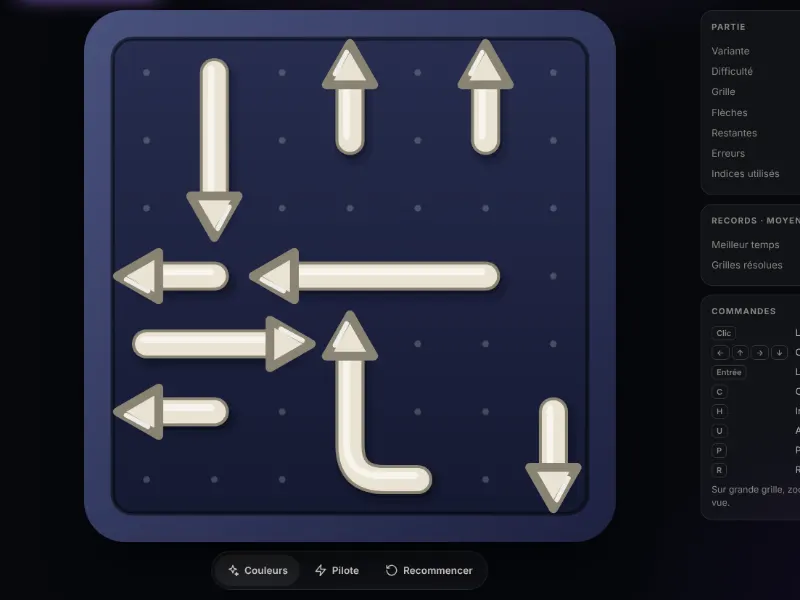
- Each arrow is a snake: a bent path that ends in an arrowhead.
- Tap an arrow: its head shoots straight ahead in the direction of the arrowhead and the body follows the path until it leaves the grid.
- If another arrow is in its way, the arrow hits the obstacle, shakes and comes back: you lose a heart (three hearts, or none in relaxed mode).
- An arrow is free when the straight line in front of its arrowhead is empty all the way to the edge. Clear them all in the right order.
Heading variant
- Each token takes up one square and carries a direction.
- Tap a token: it slides straight to the edge, where it disappears.
- If it bumps into another token, it stops against it and wakes it up: the other one sets off in its own direction, and so on (chain reaction). As soon as its path is clear, the first token resumes its run.
- A token already launched during the same tap does not set off again: it acts as a wall.
- Empty the board in as few moves as possible. The target is the best solution found by the AI: 3 stars within 15 % of the target, 2 stars within 50 %. A move that sends no token off the board counts as an error.
- Beware of dead ends: two tokens facing each other can block each other for good. The game warns you; undo or restart.
Controls
- Tap or click an arrow or a token. On large grids, zoom (button or wheel) and move the view by dragging.
- Keyboard: arrow keys to pick the neighbouring piece, Enter or Space to launch it, H for a hint, U to undo, P for autopilot, C for colours, R to restart.
- The Colours button switches between one tint per arrow and a plain single-colour look.
Modes
- Solo: time, errors and stars (in Escape: 3 stars with no error, 2 with one error, 1 with two).
- Race against the AI: same grid; the AI plays in miniature, at an adjustable pace. The first to empty their grid wins.
- Two players: same device, same grid, one after the other. The fastest wins; if the displayed times are equal, the one with fewer errors. Pass the device when the screen says so.
- Online: simultaneous race on the same grid; the best time wins.
About the AI
In Escape, the generator places the arrows one by one, making sure each one's path is clear of all those already placed: the reverse of the placing order is therefore a clearing order that always works. The hint singles out the free arrow that unlocks the most. In Heading, the construction follows the same principle; the solver combines an exact breadth-first search (small grids) with a beam search to find a very short sequence, used for the target, the hint, the autopilot and the opponent. Records only count without hints or autopilot.
Difficulty levels
- Easy5 × 5: a small grid to learn the principle.
- Medium7 × 7: more pieces and the first chain blockages.
- Hard9 × 9: deeper dependencies, you have to plan ahead.
- Expert11 × 11: a dense grid where every order matters.
- Diabolical14 × 14: the ultimate challenge, very dense and very tangled.


